Kurdish history is a history of communities, languages, political powers, regions and changing identities across the Middle East. It cannot be reduced to a single uninterrupted state or a simple list of rulers. Kurdish-speaking populations have lived under and interacted with many empires and governments, and Kurdish political identities and institutions have developed in different ways across regions and periods.

How to read this timeline: dates and labels summarize broad historical periods. Modern ethnic identities should not automatically be projected unchanged into antiquity, and maps should be read as interpretations of particular times rather than timeless borders.
1. Ancient and late-antique background
Before the medieval period: The Zagros Mountains and Upper Mesopotamia were home to many peoples and political communities, including groups recorded in ancient sources under names that historians have debated in relation to later Kurdish history. The precise relationship between particular ancient groups and modern Kurds is complex and cannot be settled by a simple one-to-one identification. Linguistic, archaeological and textual evidence each answer different questions.
Late antiquity (roughly the 3rd–7th centuries CE): The region was shaped by the Roman/Byzantine and Sasanian empires, shifting frontiers, trade, religious communities and local powers. These larger political structures influenced the environment in which later Kurdish-speaking communities developed, but they were not modern nation-states.
2. Early and high medieval periods
7th–10th centuries: Following the Arab-Muslim conquests, Kurdish-inhabited areas became part of changing Islamic political systems. Local dynasties and regional powers emerged within broader caliphal and neighboring imperial frameworks. The historical record is uneven, and the term “Kurd” did not always carry exactly the same meaning in every source.
10th–12th centuries: Kurdish dynasties and rulers held power in different parts of the region. The Marwanids, for example, ruled in parts of Upper Mesopotamia in the 10th and 11th centuries. Such dynasties are important to Kurdish history, but their political reach, identity and relationship to later Kurdish nationalism need to be described in the context of their own time.
12th century: Saladin (Ṣalāḥ al-Dīn), born into a Kurdish family, became a major political and military leader and founded the Ayyubid dynasty. The Ayyubids ruled territories across Egypt, Syria and neighboring regions. Saladin is a significant figure in both Kurdish and wider Middle Eastern history; modern national categories should not be applied to the medieval world without qualification.
3. Kurdish principalities and Ottoman-Safavid frontiers
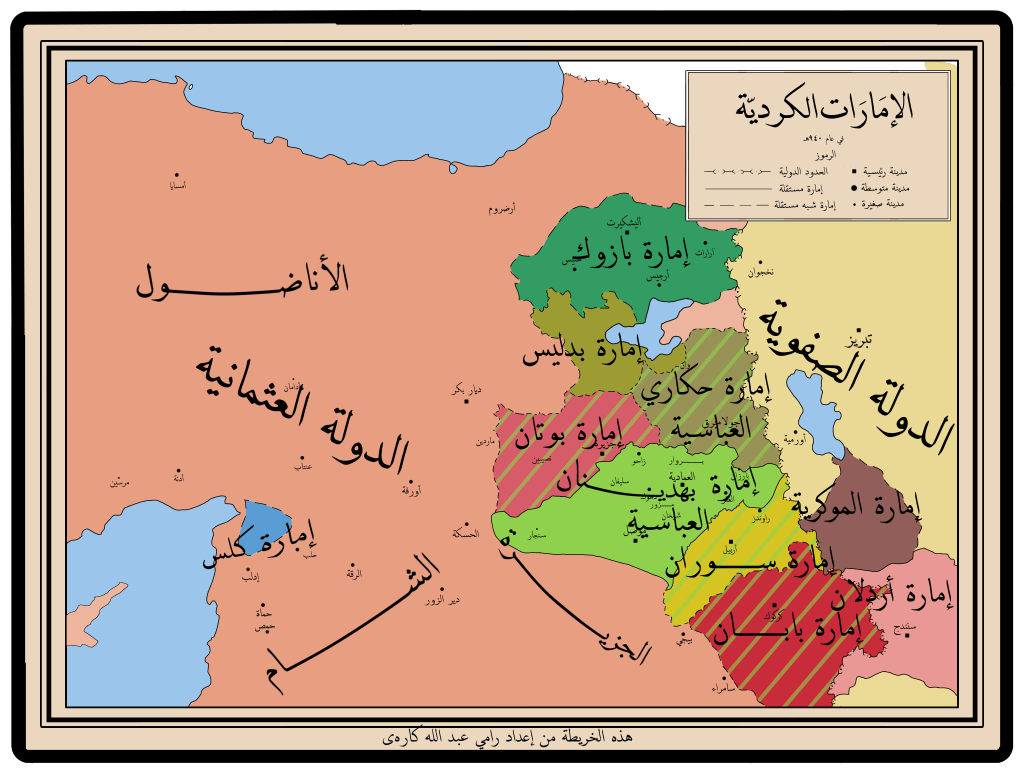
16th–19th centuries: The Ottoman and Safavid empires competed for control and influence across the region. Some Kurdish principalities and emirates exercised varying degrees of local autonomy, negotiated with imperial authorities, and sometimes fought or changed alliances. Their autonomy differed by location and period; they did not form one unified Kurdish state.
1597: Sharaf Khan Bidlisi’s Sharafnama, a major chronicle of Kurdish dynasties and principalities, became an important source for later scholarship. Like any historical text, it must be read with attention to its author, purpose, manuscript tradition and the political world in which it was produced.
19th century: Centralizing reforms and changing imperial policies weakened or transformed several local principalities. Revolts and political conflicts occurred in different areas, while new forms of administration, education, print and political thought changed regional life. These developments varied significantly between places.
4. World War I and the remaking of borders
1914–1918: World War I and the collapse of the Ottoman Empire brought profound political upheaval. Kurdish communities experienced war, displacement, new administrations and competing visions for the region’s future.
1920 — Treaty of Sèvres: The treaty included provisions for a possible process leading to local autonomy in certain predominantly Kurdish areas and a possible later consideration of independence under specified conditions. It was never implemented as written.
1923 — Treaty of Lausanne: The Lausanne settlement replaced the postwar framework established at Sèvres for Turkey’s international recognition. It did not create an independent Kurdish state. Borders and political arrangements across the wider region continued to be shaped by other agreements, mandates and state-building processes.
5. Kurdish communities in modern states
20th century: Kurdish communities came to live under the institutions and policies of Turkey, Iraq, Iran and Syria, as well as in diaspora communities. Language policy, citizenship, political participation, education, cultural expression and security differed by country and changed over time. A responsible account should distinguish the experiences of each state rather than treat all Kurdish communities as having one identical history.
1946 — Republic of Mahabad: A Kurdish-led republic was proclaimed in Mahabad in northwestern Iran. It lasted less than a year before Iranian state forces re-established control. It remains an important episode in modern Kurdish political history, although interpretations of its origins, leadership and international context vary.
1970s–1990s: Kurdish political movements, parties and armed organizations developed in different countries. In Iraq, conflict between Kurdish movements and the Iraqi state included severe repression and the Anfal campaign in the late 1980s. In Turkey, the conflict involving the Kurdistan Workers’ Party (PKK) and the Turkish state escalated from the 1980s and caused extensive loss of life and displacement. Iran and Syria also experienced distinct Kurdish political histories and state responses.
1991 and after — Iraqi Kurdistan: Following the Gulf War and subsequent developments, a Kurdish-administered region took shape in northern Iraq. The Kurdistan Region later gained formal recognition within Iraq’s federal system after 2003, with its own regional institutions. Its political, economic and security circumstances have continued to evolve.
2011 and after — Syria: The Syrian uprising and ensuing war transformed political and security conditions. Kurdish-led administrations and forces became influential in parts of northern and northeastern Syria. Their institutions, alliances and international role remain subjects of debate and change.
6. Kurdish life and identity in the 21st century
Today, Kurdish communities are diverse in language variety, religion, political outlook, regional experience and cultural practice. Kurmanji and Sorani are two major Kurdish varieties, while other varieties and local forms also matter. Kurdish literature, music, education, digital media and diaspora networks contribute to cultural life across borders. Contemporary debates include language rights, political representation, decentralization, security, displacement and the preservation of cultural heritage.
How historians study Kurdish history
- Compare sources: read chronicles, archival documents, inscriptions, oral histories and modern scholarship together where possible.
- Ask who created the source: a court chronicle, state report, memoir and oral narrative each have different purposes and limits.
- Separate evidence from memory: cultural legends are important historical evidence about identity and memory, but are not automatically proof of every event they describe.
- Check dates and geography: historical names and borders may not match modern usage.
- Represent disagreement fairly: identify contested interpretations and explain why scholars differ.


Leave a Reply